Rabinovitch Research Group
Combining Computational Fluid Dynamics (CFD) and Space Exploration!
Welcome!
In our research group, we combine an interest in space exploration with fundamental computational fluid dynamics research. Our areas of interest include investigating plume-surface interactions during powered descent of spacecraft, modeling supersonic parachute inflation, hybrid rocket propulsion for small satellites, and modeling geophysical phenomena, such as the plumes on Enceladus or Yardangs on Earth and Mars! We are always looking for new and exciting projects as well.
Interested in learning more about what we have been up to recently? Please see our Activities and News page!
A few recent highlights from the RRG:
September 9th, 2026 - The RRG and JPL start a collaboration on studying supersonic parachute inflation dynamics through the use of Fluid-Structure Interaction (FSI) simulations.
June 1st, 2026 - Prof. Rabinovitch attends the 28th Aerodynamic Decelerator Systems Conference and Seminar, which was hosted at The Royal Aeronautical Society in London, UK, and by Heathcoat Fabrics Limited in Tiverton, UK.
May 5th, 2026 - Prof. Rabinovitch gives an invited talk at the Canadian Space Launch Conference entitled “Canada's First Interplanetary Mission is Within Reach: We Should Aim for Venus.”
March 31st, 2026 - Congratulations to Danial Ghasimi on successfully defending his PhD thesis entitled “Permeability Modeling of Mars Parachute Broadcloth Materials” - Danial is the first PhD student in the RRG to defend!
March 16, 2026 - Prof. Rabinovitch, Nikk, and Miranda attend the 2026 Lunar and Planetary Science Conference (LPSC) and present a poster on ongoing work to update the Cryo-Erupt model for the Enceladus plume
March 4th, 2026 - Prof. Rabinovitch is awarded the 2024-2025 Academic Year Schaefer School Research Funding Award.
January 11th, 2026 - Prof. Rabinovitch, Andrew, and Danial all attend the 2026 AIAA SciTech Forum. Andrew presents on “High-Speed Shock/Droplet Aerobreakup Using a Sharp Interface Method,” and Prof. Rabinovitch gives an invited talk on “Some Recent Observations of Plume-Surface Interactions on Mars.”
December 4th, 2025 - Prof. Rabinovitch gives an invited talk on high-speed droplet aerobreakup modeling at the ONR MURI Review: Particulate and Precipitation Effects on High-speed Flight Vehicles - with Tom Schwartzentruber as the PI.
December 1st, 2025 - Prof. Rabinovitch visits UIUC for the day and gives the Aerospace AE 590 Seminar, presenting on recent research progress in the Rabinovitch Research Group!
November 26th, 2025 - The paper “A description of plume-surface interactions and non-dimensional analysis for crater formation” is accepted for publication in the journal Acta Astronautica! Gregory Shallcross, a technologist at NASA’s Jet Propulsion Laboratory, California Institute of Technology, is the first author.
November 23rd, 2025 - Andrew Sayad and Prof. Rabinovitch attend the 78th APS Division of Fluid Dynamics Annual Meeting in Houston, TX. Andrew gives a presentation on our recent shock/droplet aerobreakup modeling work entitled “Computational Modeling of Hypersonic Droplet Aerobreakup.” Our Cornell colleagues presented “A Dissipation-Free, Sharp Interface Method for High-Fidelity Compressible Multiphase Flow Simulations” with Chase Lee as the first author/presenter.
September 28th, 2025 - Danial Ghasimi and Prof. Rabinovitch attend the DSMC 2025 Conference in Santa Fe, NM, hosted by Sandia National Laboratories. Danial gives a presentation entitled “Modeling Low-Density Parachute Broadcloth Permeability for Mars Supersonic Parachute Inflations,” focusing on our recent rarefied permeability modeling for parachute materials.
September 3rd, 2025 - The paper “Noble gas fractionation predictions for high speed sampling in the upper atmosphere of Venus” is accepted for publication in Icarus! This paper summarizes the DSMC modeling for the VATMOS-SR Mission Concept!
August 27th, 2025 - NSF ACCESS writes a short article highlighting Danial’s recent AIAA Journal paper on parachute broadcloth permeability!
July 30th, 2025 - Prof. Rabinovitch gives an invited plenary talk at the 2025 ASME Fluids Engineering Division Summer Meeting (FEDSM) entitled “High-Speed Compressible Flows and Space Exploration!” The talk included discussions on modeling supersonic parachute inflations, modeling the Enceladus plume, and the VATMOS-SR mission concept!
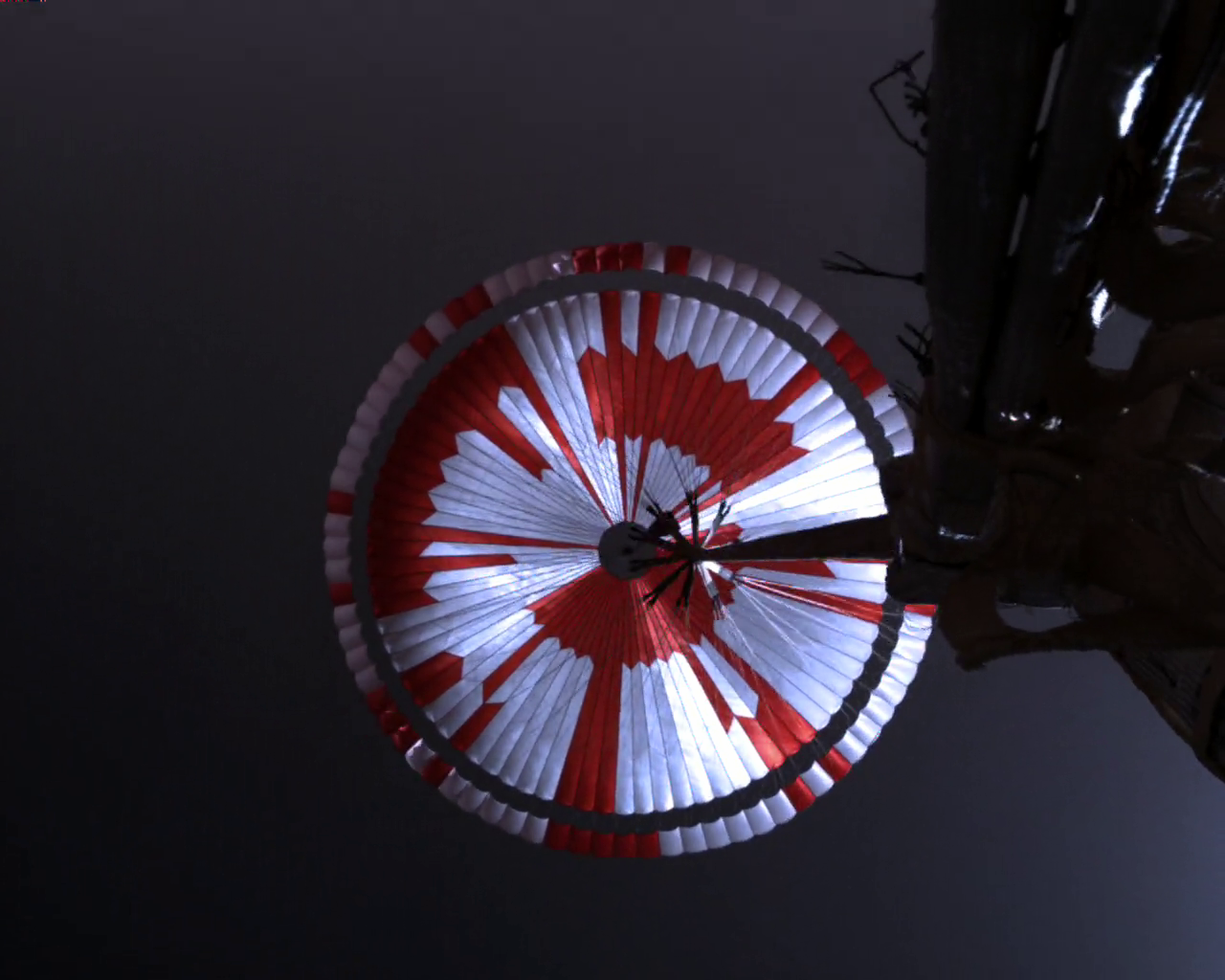
NASA's Mars Perseverance rover acquired this image during its descent to Mars, using its Parachute Parachute Up-Look Camera A. This camera is mounted on the spacecraft's backshell and looks up at the parachute. This is one still frame from a sequence captured by the camera while taking video. This image was acquired on Feb. 22, 2021 (Sol 2) at the local mean solar time of 10:24:26.
Image Credit: NASA/JPL-Caltech